Opus Dei has stake in new pope
By Matthew McAllester, Newsday, April 15, 2005
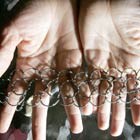 Photo by Orjan F. Ellingvag/Corbis |
A cilice is a barbed wire -like spiked chain worn around the upper thigh for two hours each day, except for Church feast days, Sundays, and certain times of the year. This is perhaps the most shocking of the corporal mortifications, and generally Opus Dei members are extremely hesitant to admit that they use them. |
ROME — Sure, Peter Bancroft said, he does use a small, cotton whip to lash his back or buttocks once a week (in private). And yes, most days he wears an abrasive metal chain around his thigh for a couple of hours that causes him discomfort but no lasting damage.
But no, neither he nor anyone in Opus Dei is a pain-loving murderer like Dan Brown’s villain in the enormously successful novel “The Da Vinci Code.”
“As soon as you meet an Opus Dei member,” said Bancroft, sitting in an ornate room in the headquarters of the conservative Catholic lay group and showing no signs of self-mutilation, “it doesn’t take long to figure out that not all Opus Dei members are masochistic monks.”
No part of the Church has been so shrouded in conspiracy theory in recent years as Opus Dei, which has 85,000 members worldwide and espouses a very conservative form of Catholicism. Critics within the Church worry about its wealth and influence; Web sites accuse it of being a cult, and Brown’s best-seller casts it as a dark, violent force within Christianity. Even its own members acknowledge it is too secretive and defensive.
New challenges
Now it faces a new challenge far from the realm of fantasy: As 115 cardinals meet in conclave Monday, there is no guarantee the next pope will treat Opus Dei with the favor Pope John Paul II bestowed upon it.
Among Opus Dei members, “Their basic concern is that they might actually end up among the big losers,” said John Allen, Vatican correspondent for the National Catholic Reporter and author of a forthcoming book on the group. But the men and women within Opus Dei insist its future is secure. Bancroft, a group spokesman, dismissed the possibility a new pope will turn against it. Opus Dei’s vision of involving lay people further in the Church “is part of the DNA of the Church,” he said, and part of the reason for John Paul’s backing.
At stake is the influence of an organization that Allen estimates has assets worth $2.8 billion worldwide and $344.4 million in the United States.
Critics within the Church usually prefer to speak anonymously about Opus Dei, citing fear of retribution and an unwillingness to make tense relationships worse. “They’re very, very powerful. … They’re so powerful it frightens people,” said a priest in Rome who has regular contact with Opus Dei. Critics say the group deliberately sets out to recruit elites — politicians, executives, journalists, lawyers and, of course, senior churchmen. Chief Vatican spokesman Joaquin Navarro-Valls is a member. Two of the 115 cardinals expected to vote in the conclave are members and two top candidates for pope — Joseph Ratzinger and Dionigi Tettamanzi — are said to be close to the group.
Under John Paul, Opus Dei made important gains. In 1992, he beatified its founder, Spanish priest Josemaria Escriva de Balaguer. Ten years earlier, the pope had given the group the status of a personal prelature, essentially turning it into the Church’s only diocese without geographical boundaries.
In spite of Opus Dei’s privileged status, some observers say its influence is overstated. “I think there’s a lot of fantasizing about Opus Dei but I don’t think there’s so much grounds for that,” said a Colombian priest, the Rev. Sergio Bernal, a professor of social doctrine at the Pontifical Gregorian University in Rome and a Jesuit, one of the clerical groups considered to be at odds with Opus Dei. And Allen said he didn’t “see in any direct way how Opus Dei is exercising any influence on the conclave.”
If Opus Dei appears murky and alien to the world, that’s partly because some of its practices can come across as throwbacks to the Middle Ages. “For people who aren’t part of that world it’s a little strange, but I don’t think there’s anything nefarious or dangerous about it,” Allen said. “I think it’s a very traditional, straight-laced, buttoned-down version of Catholic life and spirituality.”
For the first-time guest, a visit to Opus Dei headquarters is a slightly unsettling, but harmless, experience. It does not come across as secretive. Without an appointment, two visitors were welcomed by a Spanish-speaking young woman and given a tour of a series of small chapels and crypts below street level. Marble of nearly every color blended in a lavish, neo-baroque style with granite and other perfectly laid stone.
It is a custom-made network of modern design built in the 1950s and after, but reminiscent of an ancient place of worship.
Bancroft was also entirely unsecretive. Usually based in the organization’s New York center, he is a numerary, a layman committed to a life of celibacy.
Most members are supernumeraries, many of them married. Only about 2 percent are ordained priests, he said.
Mistakes made
Bancroft readily acknowledged that Opus Dei had made “mistakes” by putting “too much pressure” on some new members during initiation rites. Some former members have publicized what they saw as cult-like brainwashing techniques. “We feel bad about it,” said Bancroft, 35, of Stow, Mass., referring to any mishandling of new members.
Bancroft seemed a little embarrassed to talk about the whip, known as a discipline, and the chain — a cilice — he wears around his thigh, but said both are “a symbolic way of uniting yourself with Christ.”
(The Rev. John Paul Wauck, a professor at Opus Dei’s pontifical college in Rome, Holy Cross, noted that such acts, known as physical mortification, have long been practiced by Church members, including Mother Teresa of Calcutta.)
Only numeraries practice physical mortification, Bancroft explained. Married members of Opus Dei, supernumeraries, are exempt. “They already have enough mortification,” he said, laughing.
Since the publication of “The Da Vinci Code” in 2003, Bancroft has been unprecedentedly busy explaining Opus Dei to people. “It’s introduced lots of silliness into my job,” he said. But ironically, the novel’s dark portrayal of the organization has led some people to join, he said. “We think the more light that gets shed on us the better,” Bancroft said.
It remains to be seen if the next pope agrees.
Copyright 2005 Newsday Inc.