Vatican Intrigues: “The Passion,” the Pope, and the Phantom Review
The preview of Mel Gibson’s film sends the curia into confusion. Dziwisz and Navarro speak, and then recant. Opus Dei plays a role as well. And two thunderbolts fall from the heavens. (Original link to article below at www.chiesa.espressonline.it/english)
by Sandro Magister 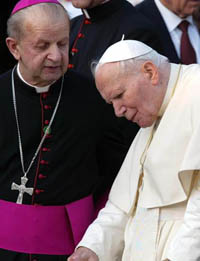
[From “L’espresso” no. 6, February 6-12, 2004]
ROMA – John Paul II seems to have recovered his health a bit. But not the Vatican curia. The men closest to the pope especially have sunk deeper into confusion. The protagonists of the latest mishap are the two men who most govern the pope’s public image: Archbishop Stanislaw Dziwisz (see photo), his personal secretary and deputy prefect of the pontifical household, and Opus Dei numerary Joaquín Navarro-Valls, the director of the Vatican press office.
The stumbling block was Mel Gibson’s recent film on the passion of Christ. It is a film that has become the matter of international intrigue even before arriving in the theaters. Dziwisz and Navarro had the idea of bringing pope Karol Wojtyla right into the middle of the quarrel. And when they sketched out a retreat, they created a disaster. They denied, both of them, that the pope had ever made the comment that the whole world heard from these very two. But let’s proceed in order.
It was Friday evening, December 5, 2003, and in his dining room John Paul II, together with Dziwisz, watched a big-screen DVD of the first part of “The Passion.” The next day they watched the second part. And the following Monday, December 8, the feast of the Immaculate Conception, Dziwisz received the four who provided the preview to the pope. They were Steve McEveety, the film’s American producer, and his wife; Jan Michelini, director’s assistant to Mel Gibson, and his father Alberto, former anchorman of Tg 1 and a Forza Italia member of parliament.
Both Michelinis are supernumeraries of Opus Dei. Jan was born, with his twin sister, in 1979, during the pope’s first visit to Poland, and upon returning to Rome it was Wojtyla himself who baptized him, the first of his pontificate. Since that time they have been very close, receiving many heavenly signs. During production, Jan Michelini was struck by lightning while was filming the crucifixion, and he was struck again on December 5, the day the pope previewed the film. On both occasions, he came away unharmed.
The conversation took place in Italian. The Michelinis translated into English for McEveety and his wife what Dziwisz related from the pope. The key phrase is the following: “It is as it was.” Eleven letters to say that the film “is just like it happened in reality.” It’s enough to signal the pope’s total endorsement of “The Passion’s” adherence to the gospels.
That Monday, December 8, Navarro also saw Mel Gibson’s film. A few days went by and, on the 16th, in the United States, “Variety” came out with the scoop: the pope had previewed the film. On the 17th, two important newspapers increased the coverage. In “The Wall Street Journal,” the most famous columnist in America, Peggy Noonan, an old-school Catholic, the author of Ronald Reagan’s most memorable speeches, made public pope Wojtyla’s phrase “It is as it was,” indicating McEveety as her first source, Dziwisz as her ultimate source, and an e-mail sent to her by Navarro as further confirmation. At the same time, in the liberal weekly “National Catholic Reporter,” Rome correspondent John L. Allen Jr. reported the identical phrase of the pope, citing as his source an “anonymous Vatican authority,” to whom he also attributed the following prediction: “There will be conversions on account of this film.”
The next day, “Reuters” and the “Associated Press” assembled further confirmation from the Vatican. And for Mel Gibson’s film, it was a beatification. By mid-December, half of the Roman curia had seen the film and been enraptured by it. Even before the pope’s entry onto the field, two very influential personages had expressed extremely favorable judgments: Darío Cardinal Castrillón Hoyos (“I am ready to exchange all of my homilies on the passion of Jesus for just one scene from Mel Gibson’s film”) and the undersecretary for the Congregation for the Doctrine of the Faith, Joseph Cardinal Ratzinger’s right hand man, the American Joseph Augustine Di Noia, a Dominican, in a long December 8 interview with the international agency “Zenit.”
Di Noia demolishes point by point the arguments of the film’s detractors. “The Passion” is not anti-Semitic, as say some, but not all, of the Jews of the Anti-Defamation League, or some of the biblical scholars of the U.S. bishops’ conference: in part because the actress who plays Mary, the Romanian Maia Morgenstern, is herself Jewish and the daughter of concentration camp survivors, but most of all because the power of the film lies in its capacity to seize and shake the viewer, every single viewer, and to make him feel, like everyone, himself a sinner responsible for the death of Jesus. Secondly, “The Passion” is not incomprehensible because the dialogue is in Aramaic or Latin: its eloquence rests entirely in the images, like the masterpieces of Michelangelo or Caravaggio, which need no translation. Thirdly, “The Passion” is not for the sentimental: it is a film of robust Catholic doctrine: “For the faithful who see it, going to Mass will never be the same.” In a word, “The Passion” is a very faithful cinematic rendition of the gospel: “It is as it was.”
So what need was there to place the pope in the middle of this worldwide chorus of the film’s supporters that already counted curial prelates and bishops (the most lively being the Franciscan archbishop of Denver, Charles Chaput), battle-hardened movements like Opus Dei and the Legionaries of Christ (the agency Zenit falls among these), neoconservative authorities of the caliber of Michael Novak or “Crisis” editor Deal Hudson, neotraditionalist pressure groups like the Institute of Christ the King and High Priest, and continental Catholic networks like the agency “Aciprensa,” which covers all of Latin America?
No; there was no need at all to bring John Paul II into the middle of this: this, at least, is what other Vatican officials think, especially in the secretariat of state. On December 24, Christmas Eve, Cindy Wooden of “Catholic News Service,” the news agency of the United States bishops’ conference, cited two anonymous prelates “close to the pope” who denied that he had made any judgment on the film.
But on January 9, John Allen of the “National Catholic Reporter” again cited his Vatican source, who confirmed that the pope had pronounced the phrase in question, adding new details. And on the 18th, in the “New York Times,” Frank Rich wrote that he had heard in English, from the “Italian translator” of the meeting between Dziwisz and McEveety, that the pope’s secretary had himself added, in commenting on the film, the adjective “incredible.”
Whom should we believe? Dziwisz, in the Vatican, had his back to the wall, and in the end he denied his own words. On January 19, he told “Catholic News Service” that “the Holy Father told no one of his opinion of the film” and that everything attributed to him “is not true.”
It was a madhouse. Jan Michelini reconfirmed his version. McEveety circulated an e-mail from Navarro telling him not to worry and to go ahead and use the pope’s fatal phrase “again and again and again.” Rod Dreher of the “Dallas Morning News” asked for further confirmation from Navarro, and he responded No, his messages to McEveety and others were never his own, they are fakes. But they all come from the same Vatican e-mail address, the same one from which the message disclaiming them was sent. On January 22, the director of the Vatican press office made an official press release: “It is the habit of the Holy Father not to express public judgments on artistic works.” But in private? One thing is certain: in public, the big lies have taken the stage.
Useful Links
The June 24 press release from the Anti-Defamation League, which reports the accusations of anti-Semitism against Mel Gibson’s film, composed by the ADL itself and by the Secretariat of Ecumenical and Interreligious Affairs of the United States bishops’ conference:
> ADL Statement on Mel Gibson’s “The Passion”
The U.S. bishops’ conference’s distancing from the judgments expressed by the experts of its Secretariat of Ecumenical and Interreligious Affairs:
> Ecumenical and Interreligious Committee Responds To News Report
The comments on the film made by Fr. Augustine Di Noia, undersecretary for the Vatican Congregation for the Doctrine of the Faith, in a December 8, 2003 interview with “Zenit”:
> Mel Gibson’s “Passion” on Review at the Vatican. Exclusive Interview with Father Di Noia
Peggy Noonan’s December 17, 2003 editorial in “The Wall Street Journal,” titled after the pope’s phrase of appreciation for the film:
The January 19, 2004 “Catholic News Service” interview with Archbishop Stanislaw Dziwisz, in which he denies that John Paul II expressed any judgment on the film:
> Pope never commented on Gibson’s “Passion” film, says papal secretary
The January 22, 2004 column in which Peggy Noonan takes stock of the intrigue of affirmations and denials:
The January 22, 2004 declaration from Vatican spokesman Joaquín Navarro-Valls:
> Dichiarazione del direttore della sala stampa della Santa Sede
The detailed reconstruction of the affair in the newsletter of John L. Allen Jr., Rome correspondent for the National Catholic Reporter:
> Update on “The Passion” – “The Word From Rome”, January 23, 2004
The dossier on “The Passion of Christ” on the website of the Latin American Catholic news agency “Aciprensa”:
> “The Passion of the Christ”. Todo sobre la Película
Another dossier in support of Mel Gibson’s film on the website of the “Istitutum Christi Regis Summi Sacerdotis”:
> Mel Gibson’s “The Passion of Jesus Christ”
On this website, on the preeminent role in the Vatican of the pope’s personal secretary, Stanislaw Dziwisz:
> Vatican Letters. The Pope and His Court (24.10.2003)
And on the director of the Vatican press office:
> Joaquín Navarro-Valls, il portavoce con la vocazione dell’ambasciatore (29.10.2002)
English translation by Matthew Sherry: > traduttore@hotmail.com
Go to the home page of www.chiesa.espressonline.it/english, to access the latest articles and links to other resources.
Sandro Magister’s e-mail address is s.magister@espressoedit.it