Testimonies and Other Writings
The following is the work of the individual author and does not necessarily reflect the views or opinions of the Opus Dei Awareness Network, Inc.
What is Opus Dei? The Alternative Version
By M. Miki, former male numerary, Brazil, São Paulo
Introduction
In this text I would like to discuss Opus Dei (or The Work) and my aim is to give support to former members. Each of the histories of former members is unique, but at the same time the histories could be quite similar. For this reason, I decided not to tell my own personal history, but my personal questions, insights and thoughts about Opus Dei.
I believe that to outsiders who do not belong to Opus Dei, some questions receive more attention than others, but in my opinion are not so important, for example, the cilice and the disciplines. In my opinion, it is more important to discuss other things, like the manipulation of the mind.
In this text, I will answer the question: “What is Opus Dei?” For the former member, an explanation of this question can give support to the existential conflict. Many times, the former member can not rebuild his own life, because this question acts like an anchor. If we can’t give an answer to this question and many others related to Opus Dei, it will be very difficult to go ahead in life to develop other personal projects. I hope the former members, especially the numeraries, receive some support from this text. I don’t want to be a model to anyone. I only want give an alternative vision. If you don’t like what you read in this text, there is no problem. My desire is that the former member find his own answers about Opus Dei and with these answers I hope the former member can be born again.
The Problem
At first, we will introduce the problem about Opus Dei by asking some questions.
How could an institution have so many different opinions about it? Some people love it. Some people hate it. Is it a matter of personal preference? Or it is like supporting a baseball team or something else? Is it only a matter of faith? Is it like saying “Believe it or not”?
These different positions about Opus Dei can be defended by two types of groups. The people who support Opus Dei say the founder of Opus Dei, Escriva, gave Catholics the option of sanctity different from the way of monks, nuns, priests etc. Escriva’s message was that the ordinary person, who has a job or takes care of the home, can become a saint. Catholics didn’t have this option of life before the foundation of Opus Dei. With this revolutionary message, Catholics can offer their work to God. A professional and job well done is an offering to God. With the message of Escriva, people can approach God and do activities like participate in the community, go to the mass, pray in a church etc. These are good things that we can’t deny.
On the other side, there are people who were manipulated by this institution for years and many were expelled for some simple excuse. Others suffered from depression and were asked to leave this organization. Most of the people that we are talking about were numeraries. These facts can´t be denied either. The defenders of Opus Dei could say that it is normal — that there are human errors in a Divine Institution like Opus Dei. But now we know that these types of error are very common (there are lots of testimonies around the world) and it is no longer possible to accept this kind of apology. Other people say that Opus Dei uses some questionable practices like alienation from their families, control of information and the environment etc.
With these facts in our hands, we can defend or we can condemn this institution. With this in mind, is it really possible to make a productive discussion about Opus Dei? Who is right? Is everybody right? Is everybody wrong? Is it a matter of framework? Depending on the context, are you right and he is wrong?
The Methodology
According to Popper [1], the way to solve a problem is: problem – theory – criticism – new problems. After describing the problem I will present a theory about “What is Opus Dei?”. This theory could be tested in many ways. If the theory “survives” after much criticism we can say that it is valid. But after accepting this theory, new problems will appear.
What is Opus Dei?
We know that many people will not accept the proposed theory. Some members will say that this is an anti-Catholic speech. Others will say that the former members are frustrated people with a lot of anger and sadness. Other people will say that we are against God. Normally the critics of the former members are not creative and they always say the same things. The theory/the model is a simple way to explain this complex institution. It is so simple and so obvious. We will present this theory only by a symbol. And the symbol is presented below:
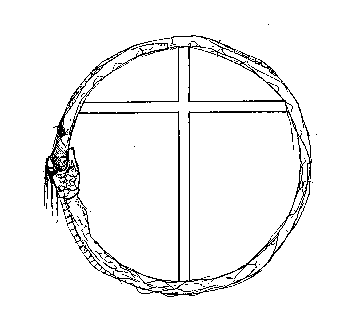
The explanation of this symbol is:
The Work is an institution with the following characteristics:
• It is an end unto itself;
• God and Catholic Church are the means of the Work.
People who know Opus Dei will recognize the symbol as a modification of the official symbol of Opus Dei. In Opus Dei, we were taught that the official symbol is represented by the Circle, which means the Globe, and the Cross, which is Christianity. The message is Christ’s Cross in the World. In the modified symbol, the Circle is a snake biting its own tail, or it is an end unto itself. This symbol is explained in the book The Power of Myth by Joseph Campbell:
“The power of life causes the snake to shed its skin, just as the moon sheds its shadow. The serpent sheds its skin to be born again, as the moon its shadow to be born again. They are equivalent symbols. Sometimes the serpent is represented as a circle eating its own tail. That’s an image of life. Life sheds one generation after another, to be born again. The serpent represents immortal energy and consciousness engaged in the field of time, constantly throwing off death and being born again. There is something tremendously terrifying about life when you look at it that way. And so the serpent carries in itself the sense of both the fascination and the terror of life.
Furthermore, the serpent represents the primary function of life, mainly eating. Life consists in eating other creatures. You don’t think about that very much when you have a nice-looking meal. But what you’re doing is eating something that was recently alive. And when you look at the beauty of nature, and you see the birds picking around – they’re eating things. You see the cows grazing, they’re eating things. The serpent is a traveling alimentary canal, that’s about all it is. And it gives you that primary sense of shock, of life in its most primal quality. There is no arguing with that animal at all. Life lives by killing and eating itself, casting off death and being reborn, like the moon. This is one of the mysteries that these symbolic, paradoxical forms try to represent.”
The symbol of the snake means that the main objective of the Work is not God. The main objective of the Work is itself. It is like other cults. The instruments used by the Work are God and the Catholic Church.
In chapter six of her book, Ser Mujer en el Opus Dei (Being a Woman in Opus Dei), former numerary Isabel de Armas describes this hair-raising vision of life in Opus Dei by using an Opus Dei priest’s description of Opus Dei.
“In the Work, we want flesh; because the flesh is able to assimilate. There are persons who are gold, but gold is never able to assimilate: what comes in, goes out. How do I tell you, we search for flesh which is the food, and it feeds the living organism which is the Work. But when we find gold, we don’t refuse it, because we buy flesh with gold; you can buy a lot of flesh.”
(Original text in Spanish “En la Obra lo que queremos es carne; porque la carne se asimila. Hay personas que son oro, pero el oro no se asimila nunca: igual que entra, sale. Como te digo, nosotros buscamos carne que alimente y nutra el organismo vivo que es la Obra, pero cuando encontramos oro, tampoco lo desechamos, porque con el oro compramos carne; se puede comprar mucha carne.”)
In the movie Conan, the Barbarian, there is a similar quotation from the killer of Conan’s parents and supreme leader of a cult: “Steel isn’t strong, boy. Flesh is stronger. That is power! The strength and power of flesh! What is steel compared to the hand that wields it?”
Consequences of the Model
Megalomania of Escriva
At the proposed model, Escriva (or the Work) is higher than God and the Catholic Church. It means that Escriva is superior to God, which means that he was a megalomaniacal person. The readers of this text could think that we are trying to ridicule Escriva. This is not the objective of this text. In this text we are making a supposition of the mental health problems of Escriva.
In Opus Dei, we were taught to admire Escriva more than Jesus Christ. Escriva is the model to imitate Christ. Escriva is always the reference to the virtues. This excessive cult to Escriva began when Escriva was alive and by himself. He was always the center of attention and he used to get angry when someone had an opinion different from his own.
When Escriva made a visit to Brazil, some members collected his fingernails as relics.
Escriva liked to tell his own histories about Opus Dei and these histories are told and retold by the members with an importance higher than the Bible. For example, the official biography of Escriva dedicated a lot of pages to an incident called the Passage through the Pyrenees. And after many versions, the published version became more important than the facts.
One of the main characteristics of a megalomaniac is the conviction of some idea which is impenetrable. We can find this impenetrable thinking in Escriva’s vision of the Work on October 2, 1928, the date of the foundation of Opus Dei. It is difficult to understand why this “vision” of the foundation was “revealed” in steps, with the introduction of the women’s branch of the Work not introduced until February 14, 1930, and the introduction of the Priests in the Work on February 14, 1943. On this day, Escriva saw the sign of the Work (the circle and the cross) and he made the foundation of the Priestly Society of the Holy Cross.
There are other examples of difficulties in understanding the “Spirit of the Work.”
In the Work, the numeraries have spiritual direction with a lay person and not with a priest because a lay person is a person of the streets. But when we saw the “vocation,” before becoming a member, we had spiritual direction with a priest and not with a lay person. Only after becoming a member, did the Work teach us that we must talk with a lay person, or with the director of a center of Opus Dei. But this director has very little experience in the real world where it is necessary to work day after day for 8 hours. This lay person works more in the internal works of Opus Dei.
The excuse of using a lay person is difficult to understand when at the top of the hierarchy there is a priest and not a lay person. The official definition of Opus Dei is a Personal Prelature. But what is a Personal Prelature? A Personal Prelature is something unique in the Catholic Church, and Opus Dei is the only one. Again the circle.
Numeraries are not allowed to keep pictures of their parents, family, and friends. This means that the numeraries must cut the bonds with their families. The only pictures of the family permitted in the centers are the pictures of the Escriva´s family. It means that Escriva didn’t give the example of cutting the bonds with his own family. The law is valid to the others, but not to Escriva.
In the Work we were taught to be extremely sincere with the director by telling everything about ourselves. But there is no obligation on behalf of the directors of the Work to tell everything about the Work to the members. Before joining Opus Dei, the numeraries didn´t know anything about cilice, disciplines, having their mail opened, etc.
The Catholic Church as an Instrument
With this model, it is possible to understand the behavior of the current members and the behavior of the former members. People who are in favor of Opus Dei only see the Cross and not the Snake. These people only see the things related to the Justice, the Grace, the Love etc. And these are the good things that attracted the former members as well, like the good messages from the books Friends of God and The Way. The supernumeraries belong to a part of the Work’s engine, different from that of the numeraries, and for them the Work is an instrument of God. We can not deny the good things in Opus Dei. But these good things are only instruments that feed the Work’s engine.
The proposed model could be considered a heresy by the Catholic Church and we will fail to demonstrate this theory because there will be a dogma which will ignore the modified symbol. If this occurs, the problem will continue unsolved.
The official model of the Work can’t explain the existence of the former members and the abuses against the former members. The subject of the former members is something prohibited in the Work.
Assuming that our model is true, we can make interpretations of other things like the Intercessors of the Work. We learned in the Work of the existence of the Intercessors of the Work, like, John Vianney, Thomas More, Saint Catherine of Siena etc. Using our model we can have an interpretation that Escriva used the devotion to the Saints to build the Work. The day to day of a numerary is controlled by the Work. But the Work is not controlled by anyone. Even the Pope doesn’t have time to control what happens in the Work. There are a lot of people near the Vatican that speak only of the good things of the Work to the Pope. The information about the abuses of the Work doesn’t reach the Pope.
An End Unto Itself
The main objective of the Work is its own development and growth. Any threat to the Work must be destroyed.
In the Work we know that it is almost impossible to take money from this institution if the benefit is not the Work. There are lots of testimonies, where a member or the family of a member, had problems with health and the Work didn’t help with money. If there is a negative balance between the inputs and the outputs of money from a member, it signals a threat to the Work, because the system will not grow. The Work should not take money from its vaults to save a member or the family of the member.
This kind of situation is only clear to a member when it happens to him or herself. If it happened to myself, the greed of the Work would become extremely clear to me. The Work doesn’t give money to poor people, because the Work says that they are the poor people. If the Work were to give money to poor people they will give it to themselves, like the schools or the institutions of the Work. These schools could be understood as a means of marketing for the Work. People would look at them and say: “The Work helps poor people.” But we understand it another way: “The Work helps itself and does everything possible to give a good image of itself, even help the poor people.”
Many people became members as teenagers and made some decisions about their professions based on the necessities of the Work, and not on their personal capabilities. Because the interests of the Work are higher than the interests of each person, some people left their jobs or their countries only to satisfy the greed of the Work. It doesn’t matter if this person will like it or not. This person must accept the will of the Work.
A numerary is only a source of energy that feeds the engine of the Work. It is like the movie “The Matrix.” The numerary is only a battery to be used up. If the battery can not be recharged, it must be thrown away. The battery could be used in different equipment and the battery doesn´t ask where it will be placed in the next machine.
Escriva could be described as a magician, because in one hand he held the attention of the good things (the vocation of sanctity, the devotion, the participation of the mass) and in another hand he hid the main objective, which is the Work itself. These tricks become clearer to the numeraries because they are closest to the hierarchy, but it is not so clear to the supernumeraries.
Final words
These are my thoughts about Opus Dei and my objective was to share my vision with other former members about this institution that I belonged to for 4 years. This alternative version could be considered a madness or a heresy. But I couldn’t find any other explanation for the bad and good facts around Opus Dei.
I hope this text could give some form of support to the former members, who suffered mental abuses and to people who believed in a dream, but in fact lived a nightmare.
And my best wishes to the former members who say the truth and are giving any type of support to other former members, like the Web sites ODAN and Opus Libros.
Footnotes
[1] Sir Karl Raimund Popper (July 28, 1902 – September 17, 1994), was an Austrian-born, British philosopher of science. He is counted among the most influential philosophers of science of the 20th century, and also wrote extensively on social and political philosophy.
References
The Power of Myth by Joseph Campbell with Bill Moyers, Doubleday, 1988.
Ser mujer en el Opus Dei (Being a Woman in Opus Dei) by Isabel de Armas, Editorial: Foca, 2002.
Posted February 7, 2005